Product · Month-end close

Run a dependency-aware close with explicit review controls.

Sebastian gives controllers evaluating AI month-end close software one persisted workspace for tasks, owners, reviewers, dependencies, files, comments, and review activity. Month-end close management starts with explicit blockers and decisions. Agent preparation remains distinct from human task completion and posting decisions.

Close orchestration

Dependencies are part of the workflow, not a spreadsheet convention.

Close tasks form a real dependency graph. A downstream task can show exactly which upstream work is blocking it, while owners, approvers, status changes, comments, files, and activity remain attached to the persisted task.

  • Task ownership, approval assignments, due dates, and status in one close workspace
  • Dependency blockers derived from the task graph instead of manually maintained labels
  • An agent receipt remains distinct from human task completion and sign-off
sebastian · close / month-end workspaceIllustrative re-enactment · demo data
Illustrative close workspaceexample states · not customer results
  • Review an upstream close blocker
    Close task graph · Dependency state recorded
    Illustrating…
  • Verify a source snapshot
    Evidence integrity · Content digest checked
    Illustrating…
  • Prepare a balanced journal draft
    Journal workflow · Pending human review
    Illustrating…
  • Approve journal creation
    Human decision · Waiting on your call
    Needs your call

Implemented product capture

The current close cockpit, rendered from a fictional workspace.

This capture was produced July 20, 2026 from Sebastian commit db9d7fa using local stub authentication and the repository's deterministic fictional Plumbline seed. It shows the implemented close UI for workstreams, task states, owners, due dates, and review queues. The visible “Recons · Sebastian working” status is a staged presentation-only indicator and does not represent a running reconciliation agent. It is not a customer result and does not demonstrate live third-party integrations.
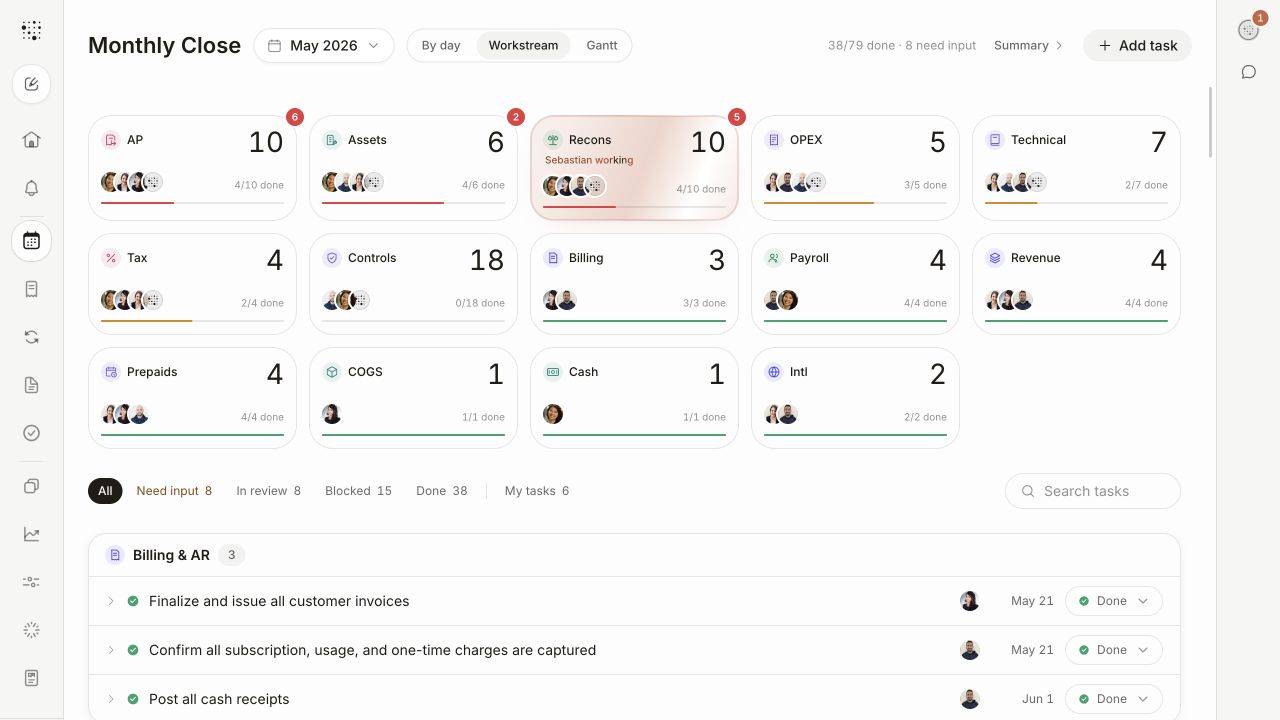
Sebastian month-end close cockpit showing fictional Plumbline workstreams and task status
Product capture · fictional Plumbline demo workspace · build db9d7fa · July 20, 2026
Review work

The workbook and the decision history survive the meeting.

Each review task can persist its workbook together with reviewer decisions, human inputs, comments, and resolution activity. Finance can return to the same record instead of rebuilding context from chat threads and copied spreadsheets.

  • Persisted review workbook tied to the close task
  • Append-only activity for reviewer decisions and human inputs
  • Files and comments remain with the work they support
sebastian · close / review workbookIllustrative re-enactment · demo data
Example close task illustrative files
illustrating…
  • csvexample-source.csvIllustrative task file · 24 KB
  • xlsxreview-workbook.xlsxIllustrative workbook · 38 KB
  • jsoncontrol-totals.jsonIllustrative snapshot · 4 KB
  • pdfreview-note.pdfIllustrative decision · 12 KB
Example files shown. Source snapshots and task attachments persist as separate records.
Agent-prepared journals

A balanced draft can enter review without posting itself.

Sebastian can read period-level journal totals and prepare a balanced double-entry draft through an explicit approval interrupt. The result lands in the journal as pending review; the agent tool does not post it directly.

  • Debit and credit totals are validated before the draft is persisted
  • Author type and an optional reasoning trace can travel with the entry
  • A reviewer can post or reject from the persisted journal workflow
sebastian · journal / pending reviewIllustrative re-enactment · demo data
Illustrative balanced journal draft
JE-DEMO-001 · example dataSebastian
Preparing example…
AccountDebitCredit
6000 · Example expense100.00
2100 · Example accrual100.00
Balanced100.00100.00
Illustrative optional reasoning trace
  1. 1Read persisted period-level journal totals
  2. 2Mapped the proposed debit and credit lines
  3. 3Validated that total debits equal total credits
What is implemented

A concrete control surface for the close.

Financial close software

Dependencies and blockers are represented in the close model and resolved from persisted task relationships.

dependency-aware
Close checklist software

Owners and approvers are attached to tasks so responsibility is visible throughout the workflow.

owner · approver
Review history

Reviewer decisions, human inputs, comments, and resolution activity remain attached to the task.

persisted
Versioned evidence

Source snapshots can retain query parameters, control totals, row counts, and content verification data.

source-bound
Balanced journal drafts

Agent-prepared entries pass double-entry validation and enter a pending-review lifecycle.

debits = credits
Clear boundary

Period locking, broad AP automation, generalized reconciliation, and ERP write-back are not represented here as shipped capabilities.

no roadmap claims
Go deeper

See the work up close.

AI accounting platform

See the broader Sebastian accounting product direction and current early-access surfaces.

Journal entry automation

Follow an agent-prepared entry from approval interrupt to pending human review.

Close automation checklist

Apply seven gates to scope, authority, exceptions, and the retained operating record.

Keep your ERP. Close and plan in one pane.

AI for accounting and FP&A on the ledger you already run. No migration. No rip and replace.

Agents at work · Matching an invoice to its PO line…