Platform · Trust and accuracy

Remain in compliance with audit-ready agent evidence & controls.

Accuracy in accounting is not a score, it is a chain of custody. Sebastian cites the policy it applied, shows the evidence it used, and refuses to act where a person has not approved, leaving a trace that holds up to the review it will eventually face.

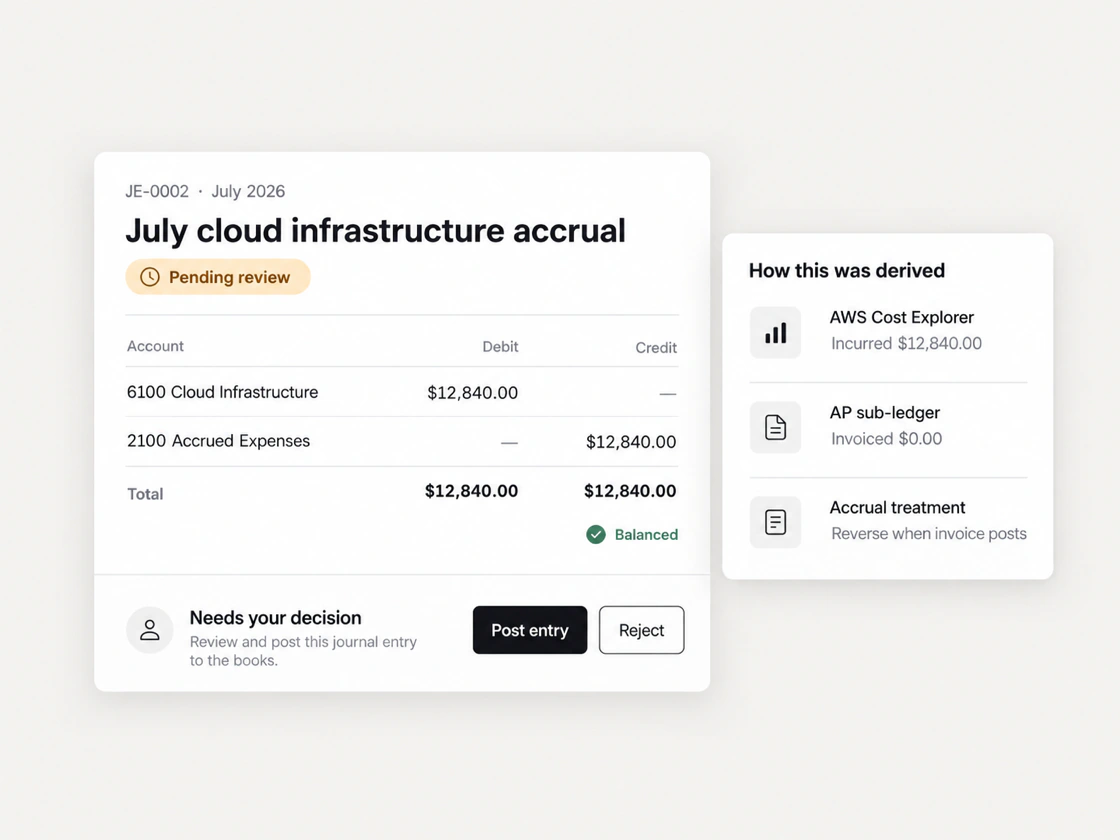
A pending cloud infrastructure accrual showing its debit and credit lines, the sources it was derived from, and the human posting decision
Agent execution model

The agent knows the difference between a rule and a judgment call.

Generic automation breaks on anything fuzzy, and black-box AI cannot be shown to an auditor. Sebastian splits the work in two, and tells you which half you are looking at.

Deterministic

rule-bound

Same answer every time.

Rule-bound work runs as a rule. A three-way match, a subledger tie-out, or a revenue schedule off a signed contract gives the same answer on every run, because a controller would not accept anything less.

  • Three-way match to the PO line
  • Subledger and bank tie-outs
  • Revenue schedules from signed terms
  • Policy thresholds and approval routing

Probabilistic

confidence-scored

Judgment, with the confidence shown.

Some work needs reading rather than rules. A messy bank description or an accrual with thin support arrives with a confidence score attached, so you know how far to trust it before you approve it.

  • Unstructured bank and invoice text
  • Accrual drafts with partial support
  • Exception triage and narrative
  • Flux commentary proposed for review
Policies are cited, not assumed

Every proposal names the rule it was decided under.

An entry is only reviewable if you can see why it was made. Sebastian applies your policies, among them capitalization thresholds, materiality limits, revenue recognition treatment, and approval chains, then names the specific one behind each proposal, so you are checking a decision rather than reverse-engineering it.

sebastian · trust / cited policy
Plumbline · July 2026 · proposed actionawaiting a person

Capitalize $18,400 to fixed assets rather than expense

Nothing posts until a reviewer approves it.

what the agent cited

  • Policy appliedCapitalization threshold · $5,000
  • SourceVendor invoice INV-2026-0509
  • SourcePO-2026-0261 · line 3
  • Approval chainController review required above $25,000
Deterministic rule · no confidence score neededrule-bound
The applied threshold or rule appears alongside the proposal
Company policy and industry treatment are applied consistently each period
Evidence assembled for review

The work arrives with its support attached, and it stays checkable.

A draft that cannot be checked is not finished work. Every proposed entry carries the calculation that produced it, the source records behind it, and a confidence score wherever judgment was involved. The source is versioned as it is used, with its parameters, control totals, and row counts, so the data in front of you later is provably the data the work was done on.

  • The calculation and the source records, attached to the proposal
  • A confidence score wherever the agent exercised judgment
  • Versioned snapshots, re-checked on the server against their fingerprint
sebastian · trust / source evidence
JE-2026-0115 · payroll accrual workpapers
attaching…
  • csvpayroll-register-2026-07.csvWorkday export · 24 KB
  • xlsxaccrual-workbook.xlsxReview workbook · 38 KB
  • jsoncontrol-totals.jsonSource snapshot · 4 KB
  • pdfreview-note.pdfReviewer decision · 12 KB
Workpapers stay with the task. The source snapshot is versioned so a later review can verify it.
Sebastian

Unify accounting data with FP&A to drive your business.

Never an unwanted action

The agent does not act where a person has not agreed.

Every entry stops for approval, so you see the proposed action and its evidence before anything happens, and an approved draft lands in pending review rather than posting itself. Draft, pending review, approved, and rejected are explicit states, which means nothing happens that a person did not want and could not check.

  • Work pauses before any entry is written, then resumes on approval
  • Approval produces a pending-review draft; a reviewer posts it to your ERP
sebastian · trust / approval
Operating account · JPMorgan ••7291 July 2026
1,260 matched · 1 exception
Bank statement
  • 07/14 ACH · AMAZON WEB SERVICES12,840.00
  • 07/15 WIRE · GRANITE PEAK INC783,000.00
  • 07/28 ACH · DATADOG8,210.00
  • 07/31 ACH · WORKDAY PAYROLL2,318,400.00
General ledger
  • INV-2026-0509 · Amazon Web Services12,840.00
  • Receipt · Granite Peak renewal783,000.00
  • INV-2026-0521 · Datadog8,210.00
  • JE-2026-0110 · July payroll2,318,400.00
07/31 FEE · JPMORGAN · 42.50
No matching entry in the ledger. Sebastian proposes a bank-charge entry; you decide.
Review
The controls of the system itself

An auditor reviews the controls, not only the entries.

Workspace isolation

Each customer’s finance data is isolated, with row-level protection on private records.

schema boundary
Field-level encryption

A defined inventory of sensitive fields is held under workspace-specific encryption, not a blanket claim over every finance column.

defined scope
Segregation of duties

Preparer and reviewer are kept separate by the system, and closed periods lock.

enforced
Go deeper

See the work up close.

Platform overview

One AI Financial Data Graph for the whole office of the CFO.

AI Financial Data Graph

How the graph is built: isolation, encryption, evidence, and integrations.

Security and trust

Tenant isolation, encryption, access controls, and segregation of duties.

Keep your ERP. Close and plan in one pane.

AI for accounting and FP&A on the ledger you already run. No migration. No rip and replace.

Agents at work · Matching an invoice to its PO line…