Planning and FP&A
Governed forecast versions, content hashing, parent diffs, and decision-report adoption.
Every decision you make is only as good as the data behind it, and that data has always had to be pulled together by hand before the analysis could even start. Sebastian keeps planning on the same graph the close runs on, so each quarter builds on the last instead of starting from a blank sheet.
Driver-based models built from actuals rather than a blank spreadsheet, with line-item support behind every assumption you have to defend.
driver-basedPlan at the granularity the business actually runs at: what marketing spent on events, what engineering consumed to ship. Not a top-line roll-up.
granularVariance against plan with drill-down to the transaction, so a conversation about a miss starts from evidence rather than a guess.
plan to actualPeriod-over-period movement with the driver already identified, prepared for review instead of reconstructed the night before.
preparedBoard decks and business reviews assembled from the same numbers the ledger holds, with every figure traceable to source.
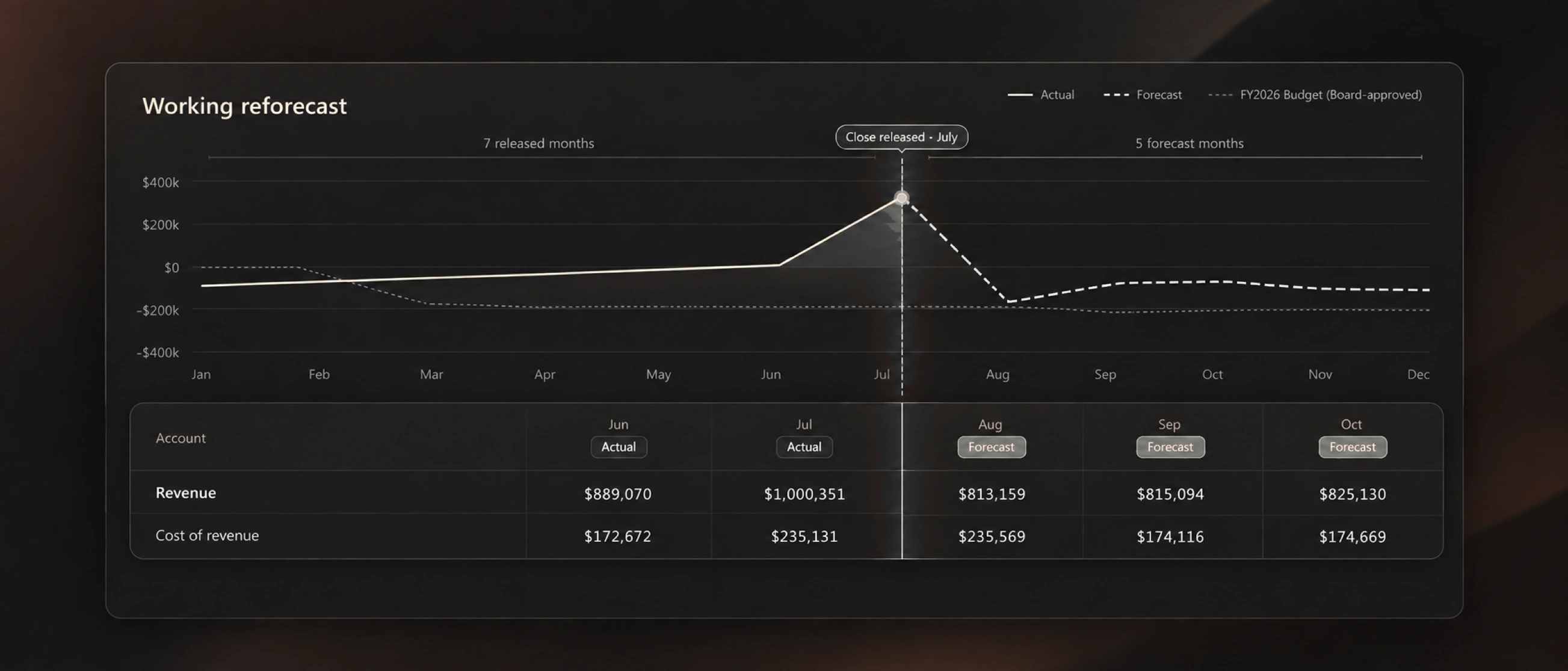
board-readyA forecast normally waits for accounting to finish, then waits again while someone reconciles those actuals against the plan in a separate system, which adds days on top of the close. When planning reads the same graph the close runs on, the forecast updates as accounting lands.
Raise Q3 opex +$1,847K: thirty-four hires land Aug 1 across three offices, and support software follows the seats.
Most FP&A tools sit too high to answer the questions department leaders actually care about. Sebastian joins department systems to accounting history on one graph, so you can build and defend a plan at the level of the spend that drives it.
Unify accounting data with FP&A to drive your business.
Actuals and plan live on the same record, so budget-versus-actual is a drill-down rather than a data request. The line-item support sits under every number, which means the conversation with a department lead starts from the transactions instead of from an argument about whose figures are right.
When actuals miss, the investigation usually happens under time pressure the night before a board meeting, the worst possible moment to be reconstructing a story. Flux runs off the same graph, so the driver behind a movement is already identified and waiting for you to review and sign.
Board decks and business reviews are built from the same record the close produced, so a figure in the deck and a figure in the ledger cannot quietly disagree. Every number carries its lineage, which is what lets you defend an assumption in the room.
Forecast the day close lands
Planning reads the same graph the close runs on, so there is no separate reconciliation step adding days on top of the close.
Department-level detail
Answer what marketing spent on events or what engineering burned to ship, instead of planning against a top-line roll-up.
Nothing to reconcile
Accounting and FP&A read one set of transactions, so the deck and the ledger cannot quietly disagree.
Governed forecast versions, content hashing, parent diffs, and decision-report adoption.
The AI Financial Data Graph the forecast and the close both read from.
The close that feeds your forecast: matching, evidenced drafts, and continuous tie-outs.
AI for accounting and FP&A on the ledger you already run. No migration. No rip and replace.