Solutions · Controller

Run your close with AI agents, not a checklist.

You are the last line of defense before actuals reach the board, and most of the close goes on assembling the work rather than reviewing it. Sebastian's agents do the matching, the drafting, and the tying out as the business happens, then hand you the exceptions.
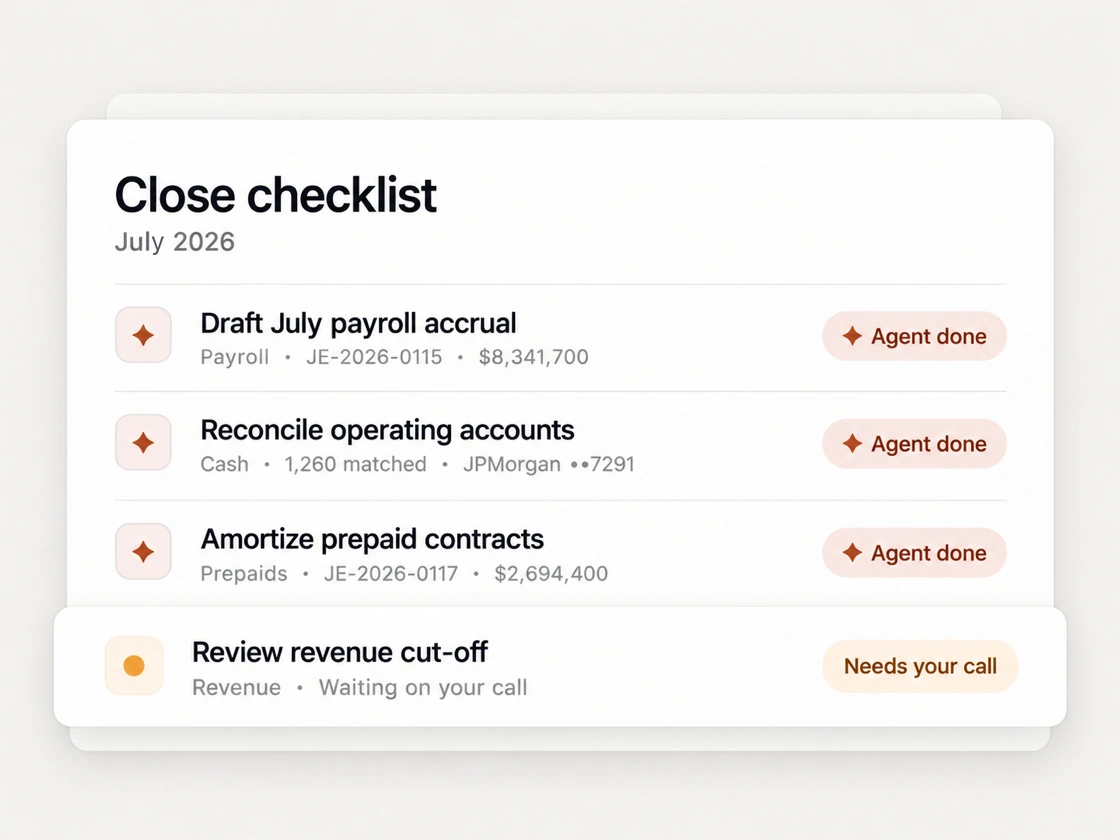
Close checklist with three tasks marked Agent done and one revenue cut-off review waiting on a person
The accounting function

Six accounting workflows, all on one ledger.

Accounts payable

Invoices match to receipts and purchase orders automatically, including the multi-line PO allocations most tools cannot handle. Exceptions resolve against live state rather than a stale export.

three-way match
Accounts receivable

Each contract becomes an ASC 606 revenue schedule, so booked, billed, deferred, and recognized stay in step every period, and each one traces to the contract line that earned it.

schedule-driven
Reconciliations

Bank and subledger tie-outs run continuously, so a break surfaces the day it happens rather than three weeks later in the audit.

continuous
Accruals and prepaids

Drafted with the work shown: the calculation, the source records, and a confidence score, built from live drivers rather than last month’s export.

evidenced draft
Revenue recognition

ARR, billings, revenue, and cash each move on their own clock, but they never drift apart, because the contract is a single node on the graph and its ASC 606 schedule comes from the signed terms.

per period
Close management

Tasks open when the upstream work has actually tied out, owners get chased automatically, and the audit binder assembles itself as the close happens.

dependency-aware
Close management

Close runs itself, your team reviews AI outputs.

Sebastian works the checklist rather than just tracking it. A task opens when the work it depends on has actually tied out, not when a date arrives, so you can see what is done, what is stuck, and who is holding it in real time, instead of in a status meeting.

sebastian · controller / close
Plumbline · July 2026 closeday 2 · 38 of 79 tasks done
  • Reconcile operating account
    Cash · JPMorgan ••7291 · 1,260 matched · 1 exception
    In progress
  • Tie out the July payroll register
    Evidence · Workday export · Control totals tied · snapshot verified
    In progress
  • Draft July payroll accrual
    Journal · JE-2026-0115 · $8,341,700 · pending review
    In progress
  • Approve JE-2026-0115
    Your decision · Waiting on your call
    Needs your call
Dependencies resolve from the close task graph
Owners, reviewers, comments, files, and activity persist in one workspace
Preparer and reviewer sign-offs accumulate as the work is done
Accounts payable

Three-way match done for you, down to the PO line.

The agent matches invoices to receipts and purchase orders, including the multi-line PO allocations most tools cannot handle. Holds and exceptions resolve against live state, so your team only reviews the handful that do not line up, not every invoice that does.

  • Multi-line PO allocation, not just header matching
  • Exceptions raised with the reason and the blocking record
  • Approved bills post to your ERP with the match evidence attached
sebastian · controller / accounts payable
Bill INV-8841 · Amazon Web Services $12,840.00 · PO-2026-0261
Held for review
Exception
Context
Direction
Follow-through
  • Quantity on the bill exceeds PO-2026-0261 line 3 by 12 units.
  • Receipt, PO line, and vendor history assembled for the controller.
  • MAAwaiting your direction
  • Accrual for the unreceived balance drafts itself; the bill posts to your ERP on approval.
Exceptions only · matched bills clear on their own
Accruals and prepaids

Drafted, evidenced, and ready for your sign-off.

Sebastian drafts accruals, allocations, and reclasses with the work shown: the calculation, the source records behind it, and a confidence score. The drivers come from live data rather than a prior-period export, so the entry reflects what actually happened this period.

  • A balanced double-entry draft, never a direct post
  • Approval before anything posts, every time
  • The draft lands pending review with its evidence attached
sebastian · controller / accrual draft
July payroll accrual
JE-2026-0115 · Payroll · PlumblineSebastian
Preparing…
AccountDebitCredit
6000 · Salaries & Wages8,341,700.00
2110 · Accrued payroll8,341,700.00
Balanced8,341,700.008,341,700.00
How Sebastian built this
  1. 1Read the July payroll register from Workday · 2,346 employees
  2. 2Pro-rated the Jul 27–31 pay period across five working days
  3. 3Validated debits equal credits and tied the total to 2110 Accrued payroll
Sebastian

Unify accounting data with FP&A to drive your business.

Reconciliations

Tie-outs that run as the business runs.

A three-way match or a subledger tie-out is rule-bound work, so it gives the same answer every time, the only standard you can sign off against. Where a bank description genuinely needs reading, the agent uses judgment and attaches a confidence score to it.

  • Deterministic matching for rule-bound work
  • Confidence scores where judgment is genuinely required
  • Matches above the confidence threshold clear on their own; exceptions wait for you
sebastian · controller / reconciliation
Operating account · JPMorgan ••7291 July 2026
1,260 matched · 1 exception
Bank statement
  • 07/14 ACH · AMAZON WEB SERVICES12,840.00
  • 07/15 WIRE · GRANITE PEAK INC783,000.00
  • 07/28 ACH · DATADOG8,210.00
  • 07/31 ACH · WORKDAY PAYROLL2,318,400.00
General ledger
  • INV-2026-0509 · Amazon Web Services12,840.00
  • Receipt · Granite Peak renewal783,000.00
  • INV-2026-0521 · Datadog8,210.00
  • JE-2026-0110 · July payroll2,318,400.00
07/31 FEE · JPMORGAN · 42.50
No matching entry in the ledger. Sebastian proposes a bank-charge entry; you decide.
Review
Audit and SOX

Audit-ready by design, not reconstructed afterwards.

The audit binder assembles itself as the close happens, so the PBC is already in hand when the auditors ask for it. Every entry carries its calculation, its source records, and its confidence score, and a person always reviews and posts, so segregation of duties stays intact.

  • Versioned source snapshots with provenance and control totals
  • Server-side content verification detects mutation of stored snapshots
  • Closed periods lock, and preparer and reviewer are kept separate by the system
sebastian · controller / evidence
JE-2026-0115 · payroll accrual workpapers
attaching…
  • csvpayroll-register-2026-07.csvWorkday export · 24 KB
  • xlsxaccrual-workbook.xlsxReview workbook · 38 KB
  • jsoncontrol-totals.jsonSource snapshot · 4 KB
  • pdfreview-note.pdfReviewer decision · 12 KB
Workpapers stay with the task. The source snapshot is versioned so a later review can verify it.
What changes

The month-end your team actually runs.

80% less manual accounting

Matching, drafting, and tying out come off your team’s plate, so the same headcount absorbs more volume as the business scales.

Toward a zero-day close

The books are effectively closed as the period ends, because the work happened continuously instead of in the first week of the month.

Ten days to a morning

Nobody spends the start of the month chasing contracts, POs, and invoices. They are already pulled, connected, and attached as evidence.

Audit-ready as you go

The binder assembles itself during the close, so the PBC is in hand when the auditors ask rather than reconstructed afterwards.

Go deeper

See the work up close.

Month-end close

Tasks, dependencies, reviewers, workbooks, activity, and source evidence in one close workspace.

Journal entry automation

Balanced agent drafts that wait for approval, then a pending human-review lifecycle.

Sebastian AI accounting

The close, journals, evidence, accounts payable, and reconciliations in one product view.

Keep your ERP. Close and plan in one pane.

AI for accounting and FP&A on the ledger you already run. No migration. No rip and replace.

Agents at work · Matching an invoice to its PO line…